Zutobi: Permit & Driving Prep
- 4.6
- Rating
- 1.00M
- Installs
- Free
- Price

 Analysis by App-foxy
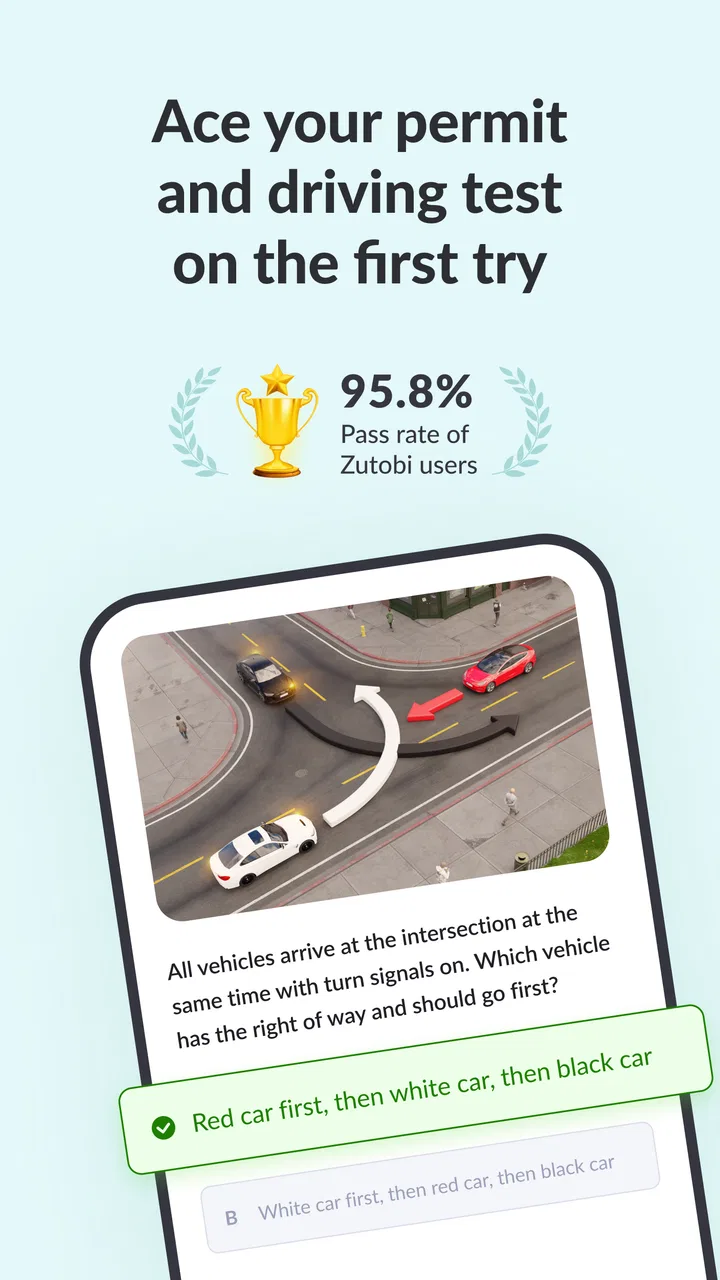
I found Zutobi: Permit & Driving Prep most useful when I treated it as a short, repeatable study companion rather than as a complete replacement for driving lessons. It is an education app from Zutobi aimed at people preparing for a permit test and building confidence before getting behind the wheel. The free starting point makes it easy to try, while optional in-app purchases range from $0.99 to $99.99 per item, so I would spend time testing the learning style before paying for anything.
My first impression was that the app understands a common problem with driver education: people often know they should study, but they do not want to sit through long, dry chapters. Zutobi breaks preparation into smaller pieces that feel easier to fit around school, work, or a busy family schedule. That approach gives it strong first-week appeal, especially for someone who keeps postponing a permit test because the official handbook feels intimidating.
Why the first week feels easy to stick with
The biggest strength is the way the app turns studying into a sequence of manageable sessions. Instead of asking me to reserve a large block of time, it encourages a quick interaction whenever I have a spare moment. That matters in real life. A learner waiting for a bus, sitting in a parked car before practice, or taking a break between classes can make progress without carrying a thick manual everywhere.
You May Also Like

 Blood Strike: 2.5 Anniversary
Blood Strike’s Loadouts Turn Every Drop Into a Tactical Gamble
A close look at Blood Strike’s custom loadouts: how fast access to signature weapons reshapes its battle royale rhythm, rewards preparation, and narrows the gap between fights.

 Pandora - Music & Podcasts
Pandora’s Music Is Easy to Start, but Harder to Recover
Pandora’s strength is its low-effort path from a seed to a station. Its weak spot is how much confidence it asks you to place in connection, setup, and quiet recovery.

 8 Ball Pool
 Is Built on Rivalries, Rematches, and Routine
A close look at the rivalries, rematches, shared routines, and unanswered safety questions that turn a quick pool match into a persistent mobile community.

 Samsung Music
’s Quiet Strength Is Playing What You Already Own
Its reach comes less from spectacle than from dependable access to a personal library. That simplicity is both the app’s strongest retention engine and its ceiling.

 AccuWeather: Weather Radar
AccuWeather Review: A Quick, Clear Forecast for Everyday Decisions
For everyday plans, the best forecast is the one you can understand quickly. AccuWeather makes rain timing, radar, and local conditions easy to act on, with a few trade-offs.

 Hill Climb Racing
Why Hill Climb Racing Still Turns Crashes Into One More Run
A tiny car, a bumpy hill and one more upgrade: Hill Climb Racing keeps resurfacing because its simple chaos makes every near-miss feel personal.
More From Our News Desk



I also liked the difference between passive reading and active recall. Reading a rule can create the comforting feeling that it is understood, but answering a question forces me to decide what I actually remember. For permit preparation, that distinction is important because test questions often depend on small details, not just broad ideas such as “drive safely.” I found the question-based approach more revealing than simply highlighting sections in a handbook.
The app’s tone is another reason it works well at the beginning. It feels less formal than a government guide, which can make a nervous learner more willing to continue after getting something wrong. That friendliness is useful for beginners who are still learning basic road language. It does not remove the need for serious study, but it lowers the emotional barrier to starting.
My practical advice is to use the first few sessions as a diagnostic rather than rushing toward completion. Notice which subjects produce repeated mistakes, then return to those areas deliberately. If signs, right-of-way situations, or defensive-driving concepts are causing trouble, random practice will not be as efficient as focusing on the weak spots. The app is most valuable when I use mistakes as a study map instead of treating them as a score to hide.
It is also worth keeping the app beside, not instead of, the official driving information for the place where you will take the test. Rules can vary by jurisdiction, and a polished learning experience cannot change that. I would use Zutobi to make the material easier to review, then check unfamiliar or especially important rules against the current official source. That two-part workflow is more reliable than trusting any single study tool blindly.
Who benefits most from the format
This is a particularly good fit for a first-time learner who needs structure. If you are unsure where to begin, the app gives you a clearer path than opening a long handbook and guessing which pages matter. It can also help a learner who understands the rules during a lesson but forgets them a day later, because frequent retrieval gives those ideas more chances to settle.
Parents and instructors may find it useful as a supplement between practical sessions. A learner can review terminology before a lesson, then discuss confusing situations with an adult afterward. That creates a useful bridge between theory and practice: the app prepares the question, while an instructor explains how the rule feels on an actual road.
On the other hand, I would not choose it as the only resource for someone who needs detailed local guidance, has difficulty learning from text and quiz prompts, or is already comfortable with the material and wants only a formal mock-test environment. In those cases, an official handbook, an instructor, or a specialized practice resource may be the better main tool.
What changes after the novelty wears off
The first-week experience is naturally the most exciting because every session feels like visible progress. The more important question is whether the app remains useful once the newness disappears. In my view, it can, but only if I give it a maintenance role. It is not the kind of app I would open endlessly for entertainment. Its lasting value comes from returning at the right moments: after a mistake, before a practice drive, or during the final preparation period.
A simple routine works better than ambitious bursts. I would rather complete a short review several times across a week than attempt one exhausting session and then ignore the subject. This is one of the non-obvious advantages of a mobile study tool: it can turn preparation into a habit without requiring a special desk, notebook, or timetable. The trade-off is that the learner has to create the discipline. The app can invite repetition, but it cannot make attention happen.
For month-to-month use, I see three sensible roles. First, it can be a foundation for someone starting from zero. Second, it can act as a refresher during the period between studying and booking the test. Third, it can help identify topics to discuss during supervised driving. That last role is easy to overlook. A question about merging or yielding becomes more useful when I bring it into a real conversation before encountering the situation on the road.
I would avoid using it as background noise. Tapping through questions while distracted may create a high completion feeling without much retention. My better method is to pause after an incorrect answer and explain the rule in my own words. If I cannot do that, I have not really learned it. This small habit makes the app more demanding, but it also makes each session more worthwhile.
How it compares with familiar alternatives
The usual alternative is the official handbook. That source has the advantage of being authoritative and comprehensive, but it can be difficult to navigate and easy to postpone. Zutobi is more approachable for daily practice, while the handbook remains important for checking exact wording and local requirements. I would not frame them as rivals; they solve different parts of the same problem.
Another alternative is a classroom course or an instructor-led program. Those options provide explanation, accountability, and the opportunity to ask questions immediately. Zutobi cannot reproduce the judgment of a person sitting beside a learner in traffic. What it offers instead is convenience and repetition between lessons. Someone who has access to a good instructor should use the app to reinforce that instruction, not to replace it.
There are also generic quiz apps. They may be fine for last-minute question practice, but I prefer a tool that encourages a learning path rather than only a stream of isolated prompts. The difference is subtle but important: memorizing answers can help briefly, while understanding why an answer is correct is more useful when the wording changes. I would still be cautious with any quiz-based resource if it makes me feel prepared without exposing gaps.
The app’s established presence is reassuring for people who prefer a widely used learning product. It has passed one million installs, carries an average rating of 4.6 from around 38 thousand ratings, and has about 3.6 thousand written reviews. Those figures suggest that many learners find the format useful, although popularity cannot tell me whether it matches my learning style or local needs.
The maintenance burden is small, but real
Keeping this app useful requires less effort than maintaining a full study system, but it is not completely automatic. I need to return regularly, pay attention to explanations, and connect the questions to the rules I am expected to know. If I only open it once every few weeks, the benefit becomes much weaker. The app works best as a light habit, not as a forgotten download that I hope will rescue me the night before an exam.
There is also a financial decision to make. The app is free to start, which lowers the risk of trying it, but optional purchases can become expensive at the upper end. I would first check whether the free experience fits my pace and whether the available material matches my needs. Paying for more content may be reasonable for someone who wants a structured preparation path, but it is harder to justify for a learner who already has a current official guide and regular instructor support.
Device compatibility is fairly broad: the current version is 4.5.57 and it requires Android 7.0 or later. That makes it accessible on many older Android devices, though I would still keep the app updated when possible. I would also avoid beginning an important study session with a nearly empty battery or unreliable connection, because mobile convenience is only helpful when the tool is available at the moment I need it.
The Everyone 10+ content rating makes it suitable for a broad audience, but younger learners should still have an adult explain situations that are difficult to understand from a screen. Driving knowledge is not just vocabulary. It involves judgment, timing, and awareness of other people. A parent or instructor can add the context that a short lesson cannot provide.
Where fatigue starts to appear
The same short-session design that makes the app inviting can eventually feel repetitive. Repeatedly answering similar questions may become tiring, especially for someone who already understands a topic. I noticed that the format demands honest concentration; it is easy to tap quickly and mistake activity for learning. When motivation drops, I would switch from broad review to a specific target, such as revisiting only the subjects I keep missing.
Another source of fatigue is the gap between screen confidence and road confidence. Getting questions right does not automatically make a learner comfortable at an intersection, during a lane change, or in heavy traffic. That gap is not a flaw unique to this app; it is a limitation of all theory-first preparation. Still, it is important not to confuse a good quiz session with readiness to drive independently.
Some learners may also find the friendly presentation too light if they prefer dense reference material. I usually see the relaxed style as an advantage at the beginning, but a serious learner may eventually want more direct consultation of official rules. That is when the app should move into a supporting role. A study tool becomes frustrating when I ask it to serve as a textbook, instructor, test simulator, and local legal reference all at once.
There is a useful way to manage that fatigue: alternate modes of learning. I might review a short set of questions, read the relevant official material, and then discuss one confusing example with an instructor or experienced driver. This prevents the app from becoming a closed loop where I memorize its patterns without improving my understanding. It also gives me a clearer answer to the question that matters most: can I apply the rule when the situation is moving and unpredictable?
Small workflows that make it more valuable
One workflow I recommend is the “mistake list.” After a session, I would write down only the concepts I missed, not every question. Later, I could review that short list before a practice drive and ask the supervising driver to create a safe example. This turns a digital error into a real learning conversation and avoids wasting time rereading material I already know.
A second workflow is to use the app before, rather than after, practical driving. If I am going to practice around intersections, I can review the relevant theory first and then watch for those decisions from the passenger seat. I would never deliberately create a risky situation to test a rule, but observing a qualified driver apply it makes the material easier to remember.
A third is to separate recognition from explanation. First I answer normally. Then, for any uncertain answer, I explain why it is correct without looking back. This exposes lucky guesses, which ordinary scores can conceal. It is a small extra step, but it changes the app from a tapping exercise into a more demanding recall tool.
Finally, I would use the app to decide when I need help, not to prove that I do not need help. Repeated confusion around one topic is a signal to ask an instructor or consult the official source. That mindset prevents the common mistake of repeating the same quiz until the answer becomes familiar while the underlying rule remains unclear.
My long-term verdict
After the first-week enthusiasm fades, I think Zutobi earns lasting space on a learner’s phone when it is used as a flexible refresher and practice companion. Its strongest qualities are accessibility, a less intimidating learning style, and the ability to turn spare minutes into useful repetition. The free entry point makes trying it sensible, while the optional purchase structure means I would evaluate the value carefully before committing to expensive content.
I would recommend it to a new permit learner who needs motivation and a clear daily routine, especially someone who keeps avoiding a traditional handbook. I would also recommend it between lessons, when a learner needs to keep rules active instead of forgetting them. The app is less suitable as the sole authority for local regulations, as a substitute for supervised driving, or for someone who already has a complete study system and dislikes quiz-based learning.
Zutobi is developed by Zutobi and has been available since June 22, 2018, which gives it a longer track record than a brand-new study app. Its current version is 4.5.57, and its broad age rating makes it approachable for many learners. Those details support the impression of a mature education product, but the real test is personal: will I return to it consistently and use mistakes intelligently?
My answer is yes, with limits. I would keep it installed during permit preparation and possibly for the period leading up to the test, but I would pair it with official local material and actual instruction. Its lasting value comes from maintenance, not novelty: short reviews, targeted correction, and honest conversations about applying rules on the road. Used that way, it is a practical addition to driver preparation rather than a flashy app that disappears after the first few sessions.
FAQs for Zutobi: Permit & Driving Prep
01What is Zutobi: Permit & Driving Prep?
Zutobi: Permit & Driving Prep is a comprehensive mobile application designed to help users prepare for their driving tests. It offers a variety of study materials, including practice tests, detailed explanations, and interactive quizzes to help learners understand road rules and prepare effectively. The app caters to different states and countries, ensuring users have accurate and relevant information.
02Is Zutobi suitable for all types of driving licenses?
Yes, Zutobi caters to a wide range of driving licenses including car, motorcycle, and commercial licenses. The app provides tailored content for each type, ensuring that users get specific information relevant to their desired license. This makes it a versatile tool for anyone looking to ace their driving test, regardless of the vehicle type.
03How user-friendly is the Zutobi app for beginners?
Zutobi is designed with user-friendliness in mind, making it accessible for beginners. The interface is intuitive and easy to navigate, with clear instructions and progress tracking features. New users can quickly get accustomed to the layout and start their learning journey without unnecessary complications, enhancing their studying experience.
04Are the practice tests in Zutobi similar to real driving tests?
The practice tests in Zutobi are crafted to closely resemble real driving tests. They include questions that are similar in structure and content to those found on official exams. This familiarity helps users feel more confident and prepared when they take the actual test, reducing anxiety and increasing the likelihood of passing on the first attempt.
05Does Zutobi provide progress tracking and feedback?
Yes, Zutobi offers robust progress tracking and feedback features. Users can monitor their advancement through various stages of study, identify areas of weakness, and receive detailed feedback on their practice test performance. This helps in creating a focused study plan and ensures that learners address all necessary topics effectively.
Pros
- Comprehensive driving test prep materials.
- Easy-to-understand lessons and quizzes.
- Engaging visuals enhance learning.
- Regular updates with new content.
- Supports multiple languages for learners.
Cons
- Requires in-app purchases for full access.
- Limited offline functionality.
- Occasional app crashes reported.
- Interface can be overwhelming at first.
- Lacks personalized feedback for users.

Zutobi: Permit & Driving Prep
Gallery